
Sunday, March 6, 2016
bird beak lab
I did an experiment called the "bird beak" experiment. The purpose of this experiment was to see how different species of animals with different alleles will prosper under different conditions. In our experiment, we found that the birds with the biggest beaks survived the longest, and the ones that were able to adapt. The graphs show that the spoonbills and the scissors shaped beak birds got the most food, and made more babies. Darwins idea of natural selection is taking place. The animals that are best adapted to survive in the given environment will thrive and their population will grow, while the ones who aren't adapted as well will fie out. Although the experiment went very well, and our results were appropriate, we didnt do everything perfectly. An error that we made was not stopping right when the alarm went off. I noticed some teammates sneaking a few pieces of food into their cup (bird stomach) after the alarm went off. These mistakes could have affected the total number of our baby chicks per year. We can fix thee problems for next time, by having someone monitor us and make sure we all end right when the alarm sounds and don't sneak extra food into our cups. Another possible thing we could have done to monitor our food intake, and to make sure we don't cheat is make a vow that we won't, and if one of us does cheat then we will be punished. Once again the main purpose of this lab was to show how natural selection controls a population, and how well they survive. For instance in the experiment the birds with a spoonbill beak will survive better because do to the size and shape of their beak, they were able to pick up the most food. In class, the main topic we learned about was natural selection and adaption. The lab helped me better understand adaption, and the idea of natural selection. I learned that animal species change gradually over time in order to better survive the environment they live in. I can apply this idea in the future when I am working with animals and studying mammalogy or herpetology in college.


Tuesday, March 1, 2016
20 time first blog post
let nature be and live? or change and die?
20 time is the process of spending 20% of your time in the classroom to focus on a topic of your choice, as long as it focuses on biology and benefits the class. The idea of 20 time originated from google, when they began allowing their employees to use 20% of their time at work doing whatever they want, as long as it benefits the company. My 20 time project is on the effects of channelization to the environment, and how it affects it. The question being asked is should channelization be allowed, and can we come up with a compromise that doesn't hurt the environment? I chose this topic to be my 20 time project because i care a lot about the environment, and the animals that live within it. It occurred to me that by channelizing the rivers and streams in this area, we kill many local species of plants and by doing that, we also kill whatever eats those plants. Not only does channelization hurt the local plant life that would be living on the riverside, but channelization can cause bad erosion further down stream. My goals for this project are to come up with a new way to get the safe effects of channelizing streams and rivers without harming the local wildlife, and causing serious erosion. I will measure my project by writing a blog ever two weeks to give an overview on how it is going, and moving forward I will wright a letter to the governor and other organizations stating my idea, and what can be done to help the cause.
20 time is the process of spending 20% of your time in the classroom to focus on a topic of your choice, as long as it focuses on biology and benefits the class. The idea of 20 time originated from google, when they began allowing their employees to use 20% of their time at work doing whatever they want, as long as it benefits the company. My 20 time project is on the effects of channelization to the environment, and how it affects it. The question being asked is should channelization be allowed, and can we come up with a compromise that doesn't hurt the environment? I chose this topic to be my 20 time project because i care a lot about the environment, and the animals that live within it. It occurred to me that by channelizing the rivers and streams in this area, we kill many local species of plants and by doing that, we also kill whatever eats those plants. Not only does channelization hurt the local plant life that would be living on the riverside, but channelization can cause bad erosion further down stream. My goals for this project are to come up with a new way to get the safe effects of channelizing streams and rivers without harming the local wildlife, and causing serious erosion. I will measure my project by writing a blog ever two weeks to give an overview on how it is going, and moving forward I will wright a letter to the governor and other organizations stating my idea, and what can be done to help the cause.
Thursday, February 25, 2016
unit 7 reflection
Unit 7 was all about ecology and the environment. A large part of this unit was about how we are affecting the environment in a bad way. We not only watched vodcasts and did activities demonstrating how the environment works, but we also talked about how plastic and other human made products are ruining this environment. The plastics and materials we use everyday send toxins and other harmful chemicals into the air. We watched two movies that really highlighted this idea. The first was "bag it", it highlighted the idea on how plastic in general is harming the world. plastic cant be dissolved or truly thrown away forever; it just sits in our oceans and on our streets. I'd like to learn more about not only the environment, but the animals that live in the environment. I'd like to explore the different traits of the animals that live in each niche. During this unit, we also did a project called the " conservation project". In this project, the purpose was to choose a certain habitat in the world and focus on how to help that local climate and niche prosper better. we worked very well in a group together, and found ways to share the work evenly. Our project was on the Citarum river, and how all of the trash that littered the banks need to be cleaned up. This unit went very well for us, and flew by like a breeze.
Thursday, February 11, 2016
Monday, January 25, 2016
gell electrophoresis virtual lab
Gel Electrophoresis Virtual Lab Worksheet Name_jake beine_
Make a prediction:
- How do you think you could figure out the lengths of the strands in the tube of DNA? We could put the DNA strands in the gel and see how far they stretch.
Go through the simulation:
- What is the process called in which we measure the DNA microscopically? Gel electrophoresis
- What is the “gel”? The filter that sorts the DNA strands.
- Write down the step of gel electrophoreses
- make the gel
- put it in the other box with water
- add an electric current to the gel
- take out the gel and stain it, then put it onto the UV light to see how the DNA has moved.
- What does the current do the DNA samples? the electric current carries the DNA away from the negative charge and through the gel.
- What kinds of strand move quickly and further down the gel? the standard sized DNA strands moved the furthest down the gel.
- What kinds of strand move slower and lag behind? The sample DNA strand moved slower and lacked behind the other strands.
- What about the strand that are the same length? they both moved the same distance from the wells that they were placed in.
- What helps us see the DNA strand in the gel? Staining the gel helps bring out the colors of the DNA and allows us to get accurate results.
- What are the ingredients to make a gel? Tris-Acetate-EDTA (TAE) ,agarose, ethidium bromide and the seaweed gel.
- After you load the DNA sample into the tray, what is the next step? connect all of the electrical cables and create a current of both positive and negative charges.
- How do you know current is running through the gel? there will be bubbles coming up through the liquid.
- After the gel is done, what must you do to it before you can analyze your results? you must put the gell in a liquid that will stain it and allow the DNA to be visible.
- How long does this process take? around 30 min of waiting time.
- What type of light do you use to view the gel? Is it safe and what precautions would you might need to use? You use UV light to see the DNA. UV is unsafe for long periods of time, so cover your skin and eyes.
- Write your size estimates below:
- Strand 1_____medium___________
- Strand 2 _____small______________
- Strand 3 _____large______________
- Could you list one reason why we would run a Gel electrophoresis on someone and explain your answer. We could use gel electrophoresis on people to determine if their related, by seeing if their DNA is similar.
Relate and Review
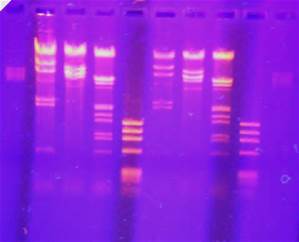
Electrophoresis is the separation of DNA, RNA and proteins from a strand. We use this to determine how big or small the DNA strands are, or to compare and contrast certain sets of DNA. I better understand how DNA can be moved throughout using electrical currents. In this experiment the DNA strands moved away from the negative charge and showed up throughout the gel. This information could come in handy later on while doing other experiments along the line of DNA and RNA strands or movement.
Sunday, January 24, 2016
unit 6 reflection
Unit 6 was an interesting unit. We learned alot about bioethics and biotechnology. Bioethics is important concepts. we Did many labs influenced by the concept electrophoresis. the ethics of medical and biological research. We went over the different ways that doctors use biotechnology to help cure diseases and defects. It has been tested on animals for years, but has just recently been used in small doses on humans. Unit 6 helped us to understand how all this works by teaching us about plasmids, restriction enzymes, ligase, PGLO and other Electrophoresis is the movement of charged particles in a fluid or gel under the influence of an electric field. This can be used for many things, but the reason we did it was to find out which food dyes are the worst for you and contain the most chemicals. I had some strengths in this unit such as being able to find the DNA pairs that match up and understanding that electricity makes the dyes move in electrophoresis. A negative of mine in this unit was my unability to understand the steps in the labs. On one lab i messed up and our results came out differently from other groups. I would love to learn more about how biotechnology can help cure mutations someday. At the beggining of the semester i made the goals to finish all CFUs and do all homework before it is due. I am exceeding on the CFUs, but i missed one homework assignment i didn’t know about. Overall this unit has helped increase my knowledge and made me a better student.

Friday, January 22, 2016
pGLO Observations , Data Recording & Analysis
1.
|
Obtain your team plates. Observe your set of “+pGLO” plates under room light and with UV light. Record numbers of colonies and color of colonies. Fill in the table below.
|
2.
|
What two new traits do your transformed bacteria have?
The bacteria is resilient to ampicillin and it glows fluorescent green.
| |
3.
|
Estimate how many bacteria were in the 100 uL of bacteria that you spread on each plate. Explain your logic.
There were around 741 total bacteria colonies. we covered the bacteria with graph paper, measured the number of bacteria clumps in that area, then multiplied it by the number of spaces that the graph paper covered.
| |
4.
|
What is the role of arabinose in the plates?
| |
Arabinose is used mainly as an inducer. Under regular temperatures and conditions the bacteria will not create fluorescent colors, but under the given conditions it will.
| ||
5.
|
List and briefly explain three current uses for GFP (green fluorescent protein) in research or applied science.
Many scientists are trying to see if it could someday cure cancer. Other scientists use it in plants and animals to see if they carry curtain plasmids. They can also figure out what different bacterias are living within organisms by putting the PGLO solution in it.
| |
6.
|
Give an example of another application of genetic engineering.
| |

Subscribe to:
Posts (Atom)